
Last updated September 10, 2026
Full 25-point door and opener safety check with every visit - springs, cables, rollers, tracks, and your LiftMaster or Chamberlain opener included
You get a price before we start. It does not change when the truck arrives.

 Before
 After
After Before
 After
After Before
 After
AfterGarage Door Repair Maintenance Checklist for Jamul Homeowners
The standard “annual tune-up” recommendation was written for a climate-controlled garage in a flat suburb. In Jamul, summer dust infiltration alone can void that interval. A gritty roller bearing fails faster than one that sees a garage door tech twice a year, and fire-season ash can compromise seals that looked fine in March. For professional help, consider our Garage Door Repair services. This guide gives you a maintenance checklist calibrated to the conditions your door actually lives in: what to do yourself, what requires a licensed technician, and how to keep records that save you money on every future service call.
Quick Answer
Jamul homeowners should inspect their garage door monthly for dust buildup, track alignment, and seal integrity; perform hands-on lubrication and hardware tightening quarterly with products selected for high-dust environments; and schedule professional service annually, with an additional post-fire-season inspection. Tasks involving torsion springs, cable tension, or opener force settings should be left to a trained technician.
Table of Contents
- Monthly Eyes-On Inspection: What to Look For
- Quarterly Hands-On Maintenance
- Annual Professional Service: What to Expect
- Fire-Season and Post-Wind-Event Protocol
- Lubrication Product Selection for High-Dust Environments
- DIY vs. Professional: The Honest Boundary
- Record-Keeping Format That Saves Money
- Common Mistakes to Avoid
- When to Call a Professional
- Frequently Asked Questions
Monthly Eyes-On Inspection: What to Look For
A ten-minute walk-around once a month catches most problems before they become expensive. We recommend the first Saturday of each month, when you’re likely already in the garage for other tasks. In Jamul’s dry climate, dust settles on horizontal surfaces within days, and that dust migrates into bearings, tracks, and opener housings faster than most homeowners expect.
Start with the door closed. Stand inside the garage and look across the bottom seal. Light leaking through indicates compression loss. In Jamul, where Santa Ana winds drive embers and fine ash during fire season, a compromised bottom seal is not merely an energy issue. It is an entry point for debris that abrades rollers and contaminates lubricant. Press the seal with your finger. It should rebound to shape. Cracks, flattening, or hardening mean replacement is near.
Next, examine the tracks. Run your eyes along both vertical sections from bottom to top, then the horizontal runs toward the opener. Look for:
- Dust or grit accumulation that has formed a visible line along the track interior
- Dents, bends, or separation from the wall mounting brackets
- Evidence of roller wobble, such as wear marks on the track edges
- Rust spots, which in Jamul’s low-humidity environment usually indicate previous water intrusion from washing vehicles or sprinkler overspray
Operate the door once and watch. The movement should be smooth, without hesitation or noise variation. Listen specifically for grinding, which suggests dry rollers or track contamination, and for rhythmic clicking, which often indicates a failing roller bearing. Note the date and any observations in your maintenance log.
Check the safety sensors at the base of the tracks. The LED indicators should be steady, not flickering. Wipe the lenses with a dry cloth. Dust film on sensors is a leading cause of phantom reversals in Jamul homes, where airborne particulate is simply higher than in coastal San Diego neighborhoods.
Finally, inspect the exterior weatherstripping around the door frame. Jamul’s temperature variance, summer highs near 100°F and winter lows in the 30s, causes vinyl and rubber to cycle through expansion and contraction repeatedly. Look for gaps at the corners, where material tends to pull away first.
Quarterly Hands-On Maintenance
Every three months, perform the tasks that require tools and direct contact with moving parts. Schedule this for March, June, September, and December to align with seasonal transitions in Jamul.
Step 1: Clean the Tracks
Do not lubricate the tracks. This is a common error that attracts dust and creates a grinding paste. Instead, wipe the interior surfaces with a damp cloth to remove dust buildup. For stubborn residue, use a mild degreaser, then dry thoroughly. In Jamul, we see track contamination accelerate noticeably between June and September when dust levels peak.
Step 2: Lubricate Moving Parts
Apply lubricant to roller bearings, hinge pivots, and the torsion spring (if visible and if you are certain it is a standard torsion system, not an extension spring). Use a product selected for high-dust environments, detailed in the lubrication section below. Operate the door twice after application to distribute the lubricant.
Step 3: Tighten Hardware
With the door closed, check all visible nuts and bolts on hinges, brackets, and track supports. Use a socket wrench, not a screwdriver, for secure tightening. Do not overtighten; snug is sufficient. In Jamul’s temperature-cycling environment, thermal expansion and contraction loosen hardware faster than in moderate climates.
Step 4: Test the Balance
Disconnect the opener by pulling the release handle. Manually lift the door to waist height and release. A properly balanced door stays in place. If it rises or falls, the spring tension is incorrect. Note this in your log and call a professional. Do not attempt spring adjustment yourself.
Step 5: Test Safety Features
- Place a solid object, such as a scrap 2×4, in the door’s path and close it. The door should reverse within two seconds of contact.
- Wave a broomstick across the sensor beam during closing. The door should reverse immediately.
- Check the emergency release. Pull the red handle; the door should move freely by hand. Re-engage the opener according to manufacturer instructions.
If any safety test fails, discontinue automatic operation and call for service. A door that fails the reversal test is a liability hazard, particularly in homes where grandchildren visit.
Annual Professional Service: What to Expect
Once per year, a qualified technician should perform tasks that require specialized tools, training, and safety protocols. In Jamul, we recommend scheduling this service in early spring, before summer dust loads peak, with a second inspection after fire season if conditions warrant.
A professional annual service from Garage Door Repair in Jamul should include:
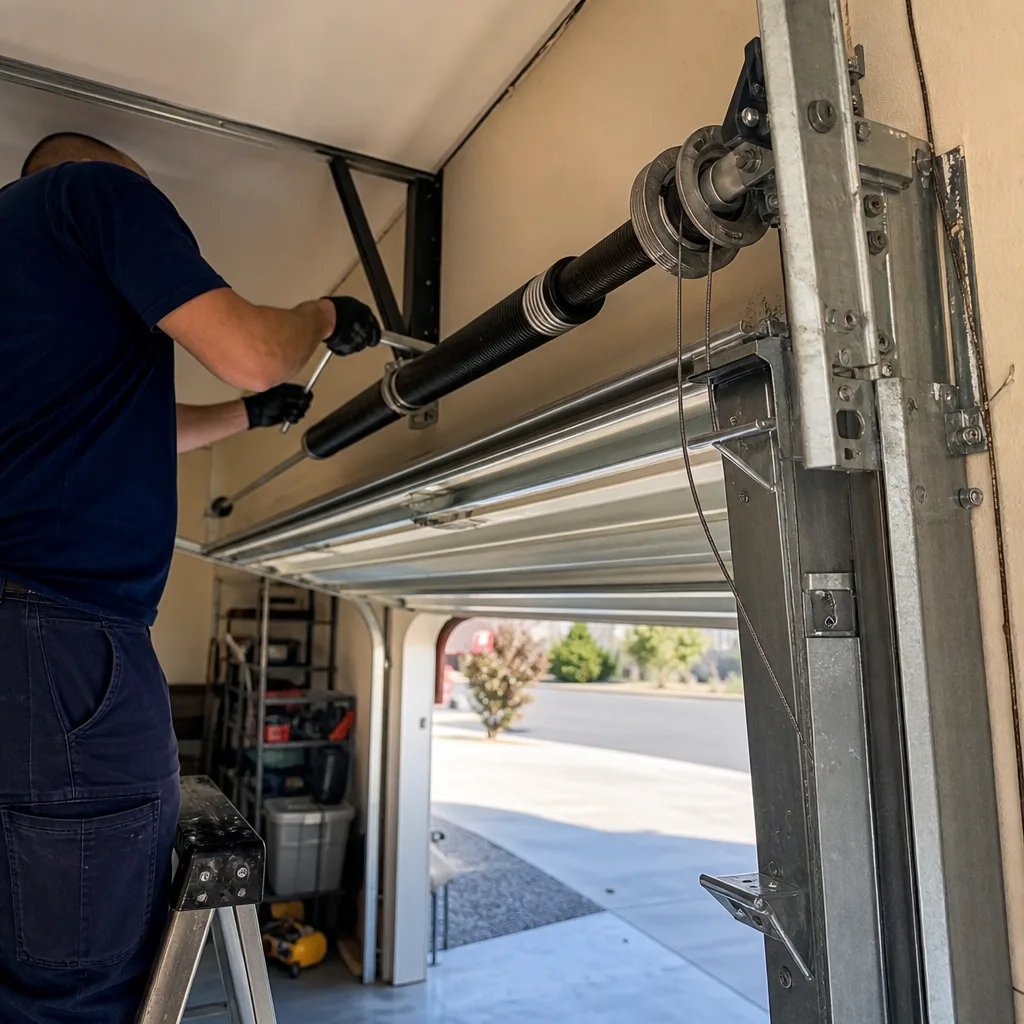
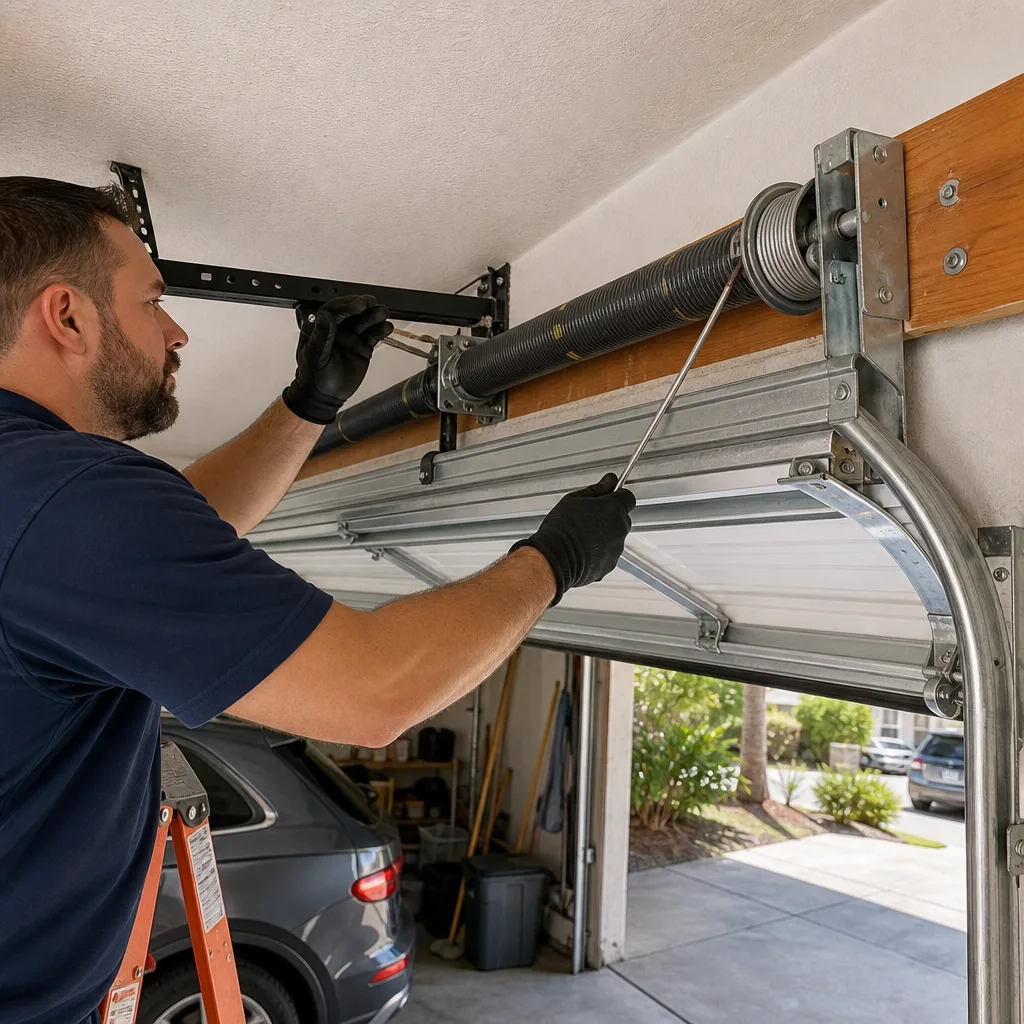
- Torsion spring tension measurement and adjustment to factory specification
- Cable inspection for fraying, corrosion, or improper winding on the drum
- Opener force and limit settings verification with a calibrated gauge
- Roller replacement assessment, including stem wear and bearing condition
- Panel structural inspection for stress cracks, particularly in steel doors with Jamul’s thermal cycling
- Full safety system test with documentation
The technician should provide a written report with measurements, not merely a checklist of “checked” items. At Mainspring Garage Door Co., our annual service includes torque readings on spring systems, amperage draw on the opener motor, and a photograph of cable drum alignment. This documentation becomes part of your door’s service history and helps future technicians diagnose intermittent problems faster.
Ask specifically whether the technician will inspect the header bracket and opener mounting. In older Jamul homes, particularly those built in the 1980s and 1990s, header brackets were sometimes fastened to trim rather than structural framing. Vibration from daily operation loosens these mountings progressively. A technician who merely lubricates and leaves has not completed the service.
The Mainspring Garage Door Co. home page details our $89 Seasonal Tune-Up, which covers all annual service items. For most Jamul homeowners, this is the most cost-effective maintenance investment they make on their home.
Fire-Season and Post-Wind-Event Protocol
Jamul’s location in San Diego County’s eastern foothills places it within California’s wildland-urban interface. Fire season, broadly May through November, brings Santa Ana wind events that drive embers, ash, and fine debris into garage spaces through gaps that would be negligible in other climates.
After any significant wind event, particularly when regional fire activity is occurring, perform an additional inspection within 48 hours. This is not alarmism. Ash particles are abrasive. When they infiltrate roller bearings and hinge pivots, they accelerate wear rates by a factor we have observed to be two to three times normal in Jamul service calls during October and November.
The post-wind-event checklist:
- Examine the bottom seal for embedded debris. Remove visible material and test seal compression.
- Check weatherstripping around the frame for displacement or tearing from wind pressure.
- Inspect the track interior for ash accumulation. Wipe clean if present.
- Operate the door and listen for noise changes from the pre-event baseline in your log.
- Examine the exterior door surface for ember damage, particularly on wood-composite doors.
If you observe ember penetration or seal compromise, schedule service promptly. Garage Door Installation in Jamul sometimes becomes necessary when fire damage has compromised panel integrity, but early seal replacement often prevents larger problems.
For homes in higher-exposure areas near Jamul’s open spaces, consider upgrading to intumescent seals and metal-edge weatherstripping. These materials resist ember contact better than standard vinyl products and maintain seal integrity at higher temperatures.
Lubrication Product Selection for High-Dust Environments
The lubricant you choose matters more in Jamul than in most San Diego County locations. Standard spray lubricants, particularly those with petroleum distillate carriers, leave a tacky film that attracts dust. Within two weeks of application in Jamul’s summer conditions, this film becomes an abrasive slurry that increases rather than decreases wear.
We recommend lithium-based greases or synthetic lubricants formulated specifically for high-dust environments. Look for products labeled “non-tacky” or “dust-resistant.” Apply sparingly. Excess lubricant serves no purpose and compounds the contamination problem.
Avoid WD-40 for garage door maintenance. It is a water displacement formula, not a lubricant, and its light carrier evaporates within days leaving minimal protective film. We see this mistake repeatedly in Jamul service calls where homeowners applied WD-40 two weeks prior and now have dry, noisy hardware.
For torsion springs, use a lithium spray with a straw applicator for precise placement. Apply a thin line along the spring coils, then operate the door to distribute. For roller bearings, remove each roller from the track if possible, apply grease to the bearing cavity, and reinstall. If the roller is a sealed bearing type, lubricate the stem where it pivots in the hinge.
Never lubricate the opener chain or belt unless the manufacturer specifically requires it. Most modern openers, including LiftMaster and Chamberlain belt-drive units, use maintenance-free components. Incorrect lubrication attracts dust and can degrade belt material.
Genie screw-drive openers are an exception. These units require annual lubrication of the screw with the manufacturer’s specified compound. If your Jamul home has a Genie screw-drive unit, confirm the correct product in your owner’s manual and apply precisely as directed.
DIY vs. Professional: The Honest Boundary
We believe homeowners should understand exactly what they can safely do and what genuinely requires a trained technician. The boundary is not about protecting our trade. It is about physics that can injure or kill.
Safe Homeowner Tasks
- Visual inspection of all components
- Cleaning tracks with cloth and mild cleaner
- Lubrication of rollers, hinges, and visible spring coils
- Hardware tightening to snug fit
- Safety sensor cleaning and alignment verification
- Weatherstripping replacement on frame-mounted seals
- Remote battery replacement and keypad programming
Tasks Requiring a Licensed Technician
Torsion spring adjustment or replacement. A standard residential torsion spring stores enough energy to lift a 200-pound door. When wound, it stores roughly 1,000 foot-pounds of torque. The winding bars used to add or release tension must engage fully in the cone holes. A partial engagement, a slipped bar, or a miscalculation of wind direction causes immediate, violent release. We have seen broken wrists, facial fractures, and worse from homeowners who watched a video and attempted this. The risk is not theoretical.
Cable replacement. Garage door cables are under constant tension, even when the door is open. They can whip unpredictably when detached from the drum or bottom bracket. Proper cable service requires releasing spring tension first, which returns to the torsion hazard above.
Opener force and limit setting. These adjustments determine how hard the door pushes before reversing. Incorrect settings create entrapment risk, particularly for children and pets. Modern openers, including current LiftMaster and Chamberlain models, require calibrated force gauges for proper adjustment, not guesswork.
Panel replacement or section repair. Doors are balanced as complete systems. Removing or adding weight without recalculating spring tension causes immediate operational problems and safety hazards.
We state this plainly because we have been called to Jamul homes where a well-intentioned homeowner created a dangerous situation attempting to save money. Our Garage Door Opener in Jamul service includes force calibration with documented readings, not merely button programming.
Record-Keeping Format That Saves Money
A simple maintenance log reduces diagnostic time on every future service call, which reduces your bill. Technicians charge for time spent determining what previous work was performed and when. A clear record eliminates that time.
We recommend a single-page format, kept on a clipboard in the garage or as a digital note shared with all household members. Include:
- Door specifications: Manufacturer, model, size, material, installation date, and any modifications
- Opener specifications: Brand, model, horsepower, drive type, installation date
- Spring system: Torsion or extension, wire size if known, number of springs, last replacement date
- Service entries: Date, technician or company name, work performed, parts replaced, measurements taken, invoice number
- Homeowner maintenance: Date, tasks performed, observations, product used for lubrication
Specific measurements matter. “Spring adjusted” tells a future technician nothing. “Torsion spring torque measured at 32.5 inch-pounds, adjusted to 34 inch-pounds per door specification” provides actionable information. At Mainspring Garage Door Co., we provide this level of documentation on every service call because it serves the homeowner long after we leave.
Photographs add value. A photo of cable drum alignment, roller condition, or seal compression can be compared year to year to track gradual deterioration that is invisible in memory alone.
For Jamul homeowners who have been in their homes fifteen or twenty years, this record also supports insurance claims. If fire, wind, or vehicle damage occurs, documented maintenance history demonstrates due diligence and can affect claim resolution.
Common Mistakes to Avoid
- Lubricating the tracks. Tracks are not meant to be lubricated. The rollers roll; they do not slide. Lubricant on tracks attracts dust and creates an abrasive film that accelerates wear on both rollers and track surfaces.
- Using the wrong lubricant in Jamul’s dust environment. Standard spray lubricants with tacky carriers become dust magnets within days. The result is worse than no lubrication at all.
- Ignoring seasonal variance. A maintenance schedule developed for coastal San Diego fails in Jamul. The dust load, temperature swing, and fire-season exposure require more frequent inspection and different product choices.
- Testing safety features only when something seems wrong. Monthly testing catches sensor misalignment before it causes property damage or injury. The two-by-four test takes thirty seconds.
- Attempting spring or cable work after watching online videos. Video demonstrations rarely show the full safety protocol, and they never convey the stored energy in a wound torsion spring. The cost of professional service is trivial compared to emergency room bills.
- Replacing only one spring on a two-spring system. Springs age together. A new spring paired with an old spring creates imbalance, strains the opener, and typically fails within months. We see this in Jamul homes where a previous installer cut corners.
- Neglecting the opener mounting and header bracket. A loose header bracket allows opener vibration to damage the door and creates safety risk. This is inspected during professional annual service, not homeowner maintenance.
When to Call a Professional
Call for service when you observe any of the following: the door reverses unexpectedly or fails to reverse on contact; a spring shows visible gaps in the coils; a cable is frayed, unwound from the drum, or detached; the opener motor strains audibly or trips its thermal overload; the door hangs crooked in the opening; or you have attempted a repair and the problem persists or worsens. For a full list of symptoms, refer to our Garage Door Warning Signs: A Jamul Homeowner’s Reference Guide.
Carl Dutton and the team at Mainspring Garage Door Co. offer free estimates in Jamul. A technician arrives with springs, cables, rollers, and openers on the truck, so most repairs are completed in a single visit. The flat price is stated before any work begins. Call (619) 333-5822.
Frequently Asked Questions
Jamul homeowners should perform monthly visual inspections, quarterly hands-on maintenance, and annual professional service, with an additional post-fire-season inspection after significant wind events. The dust and ash exposure in Jamul’s environment makes the standard “once a year” recommendation inadequate for reliable operation. Explore more guides & resources for year-round maintenance tips. Call (619) 333-5822 to schedule your $89 Seasonal Tune-Up.
Homeowners can safely lubricate rollers, hinges, and visible torsion spring coils with the correct product. Torsion spring tension adjustment, cable service, and opener force calibration require a trained technician due to injury risk. Use a non-tacky lithium or synthetic lubricant formulated for high-dust environments, not standard spray lubricants that attract grit.
Use a lithium-based grease or synthetic lubricant labeled specifically for high-dust or non-tacky applications. Avoid WD-40 and standard spray lubricants with petroleum distillate carriers, which leave a tacky film that attracts Jamul’s airborne dust and creates abrasive slurry on moving parts. Apply sparingly; excess lubricant compounds the contamination problem.
Signs of spring failure include visible gaps between coils, a door that feels heavy to lift manually, a door that falls when released at waist height, or an opener that strains audibly. Torsion springs typically last 7 to 12 years depending on cycle count. In Jamul’s temperature-cycling environment, thermal expansion stress can accelerate fatigue. Never attempt spring replacement yourself. Call (619) 333-5822 for an inspection and exact quote.
Inspect the bottom seal after any significant wind event during fire season. Look for embedded ash, hardening, cracks, or compression loss. A compromised seal allows abrasive debris into the track system and can admit embers during active fire conditions. Replacement is straightforward and inexpensive compared to the damage prevented. If the seal is damaged or the door lacks an intumescent seal in high-exposure areas, schedule service.
No. At Mainspring Garage Door Co., the flat price is stated and agreed before any work begins. The estimate is based on your description and any photos you provide, then confirmed on-site before tools are opened. There are no surprises on the bill. This is our standard practice on every job, and it is stated in writing on the 90-Day Done Right Promise.
The Bottom Line
A garage door maintenance checklist calibrated to Jamul’s conditions requires more frequent attention than generic advice suggests. Monthly eyes-on inspection, quarterly hands-on work with dust-appropriate products, annual professional service with documented measurements, and post-fire-season seal inspection keep your door reliable and your costs predictable. The tasks you can do safely are straightforward. The tasks that require a professional are genuinely dangerous and should not be attempted. Keep a simple log, and every future service call will be faster and less expensive. The door on your Jamul home protects vehicles, storage, and often direct access to your living space. Maintenance is not an expense. It is the avoidance of larger expense and inconvenience.
Written by Carl Dutton, Owner at Mainspring Garage Door Co., serving Jamul since 2016.