
Last updated September 10, 2026
Full 25-point door and opener safety check with every visit - springs, cables, rollers, tracks, and your LiftMaster or Chamberlain opener included
You get a price before we start. It does not change when the truck arrives.
 Before
 After
After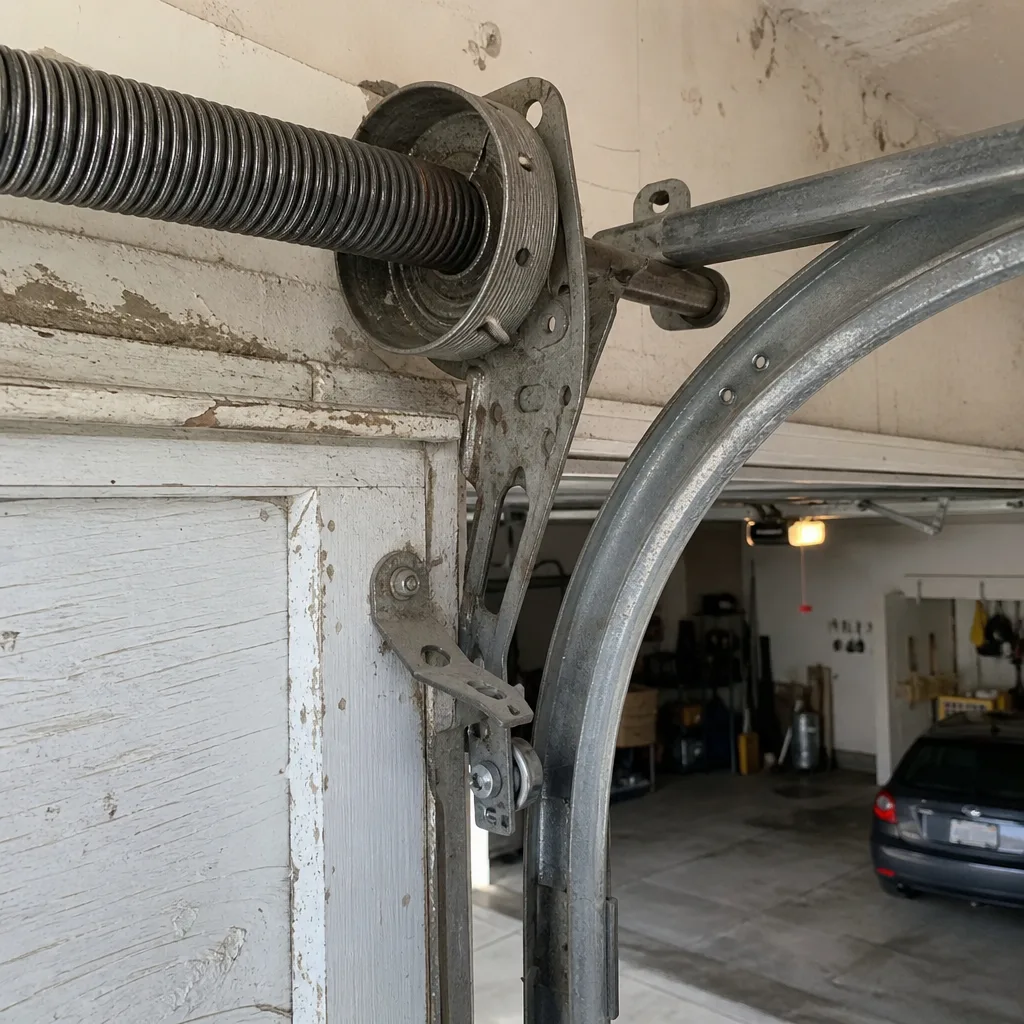 Before
 After
After Before
 After
AfterDIY vs Professional Garage Door: The Jamul Homeowner’s Decision Guide
A torsion spring stores roughly the same kinetic energy as a coiled rattlesnake, and it releases just as fast. That danger doesn’t diminish because you finished your own kitchen backsplash or rewired a ceiling fan. Yet most garage door guides lump every repair into the same bucket, either scaring homeowners away from a five-minute sensor adjustment or encouraging them to wind a spring with a pair of Harbor Freight bars. For a clearer look at what different repairs actually cost, see our Garage Door Cost Breakdown: The Jamul Homeowner’s Reference for 2026. In Jamul, where many homes sit on sloped lots with heavy wind-rated doors and where a trip charge from an out-of-area dispatch can top $150 before any work begins, knowing exactly where the line falls matters to your safety and your wallet. This guide draws that line task by task, without the usual fear tactics or false confidence.
Quick Answer
Most Jamul homeowners can safely handle sensor realignment, weatherstrip replacement, roller lubrication, and remote programming on their own. Torsion spring replacement, cable work, and structural header repairs should always go to a trained technician because the stored energy and precision tolerances create danger that does not decrease with handiness. The middle ground - removing old weatherstrip, clearing track debris, or testing door balance - lets you reduce billable hours without touching components that can injure you. For a full rundown of what you can safely tackle yourself, check our Garage Door Repair Maintenance Checklist for Jamul Homeowners.
Table of Contents
- The Physics of Torsion Springs: Why Some Jobs Stay Dangerous
- Safe DIY Tasks: What You Can Handle Without Risk
- Never DIY: Repairs That Require a Professional Every Time
- How to Assess Your Own Garage Door Setup
- The True Cost of a Botched DIY Repair in Jamul
- The Middle Path: Prep Work That Saves Money Without Risk
- When to Call a Professional
- Frequently Asked Questions
The Physics of Torsion Springs: Why Some Jobs Stay Dangerous
A standard residential torsion spring for a 16-foot wide door in Jamul carries between 9,000 and 12,000 inch-pounds of torque when fully wound. That’s not an abstract number. It translates to roughly 100 pounds of force concentrated in a steel coil less than two inches in diameter, and it releases in milliseconds if the winding cone slips, the cable breaks, or the winding bar is inserted improperly.
The human wrist breaks at roughly 150-200 pounds of direct impact. A torsion spring can deliver multiples of that. We have seen experienced carpenters and retired engineers - people with decades of tool time - suffer compound fractures because they assumed their general competence transferred to spring work. It doesn’t. The danger is specific to the component, not the operator.
Here’s what happens during a failure. The spring unwinds instantaneously, the winding cone spins free, and the bar you’re holding becomes a rotating lever arm. If you’re standing in the typical position, that bar strikes your forearm or ribs before you can release it. The door itself, now unbalanced, slams down with 150 to 400 pounds of sectional weight depending on whether you have a steel Clopay or an insulated Amarr in a wind-rated configuration common in Jamul’s higher-elevation zones.
Extension springs carry less stored energy per spring but introduce a different hazard. The safety cable threaded through the spring is often missing or rusted through on older Jamul homes, particularly in rural parcels off Lyons Valley Road where maintenance cycles stretch longer. When an extension spring breaks without that cable, it becomes a projectile that can travel 20 feet. We have found springs embedded in garage sheetrock and, in one case, a truck’s fiberglass bed cover.
The point is not to frighten you away from your own garage. It is to separate the component from your self-assessment. You may be genuinely skilled. The spring does not know that.
Safe DIY Tasks: What You Can Handle Without Risk
These tasks involve no stored energy, no structural load, and no precision tension. They are genuinely within reach of most Jamul homeowners and can solve a surprising percentage of common complaints.
Sensor Realignment
Photo-eye sensors sit six inches off the floor on either side of the door track. When the LED on one side turns from steady to blinking, the beam is interrupted. Causes include knocked brackets, accumulated dust from Jamul’s dry seasonal winds, or spider webs in the housing.
- Unplug the opener or turn off the breaker - not because the sensors carry voltage that will harm you, but because the door will not attempt to close while you work.
- Loosen the wing nut or thumb screw on the bracket. Do not remove it fully.
- Adjust until both LEDs show steady illumination. Most Genie and LiftMaster units use green for aligned, red or orange for interrupted.
- Tighten the bracket and test by closing the door with the remote, then breaking the beam with your foot. The door should reverse within two seconds.
If both LEDs stay dark, check for pinched wiring along the track run, particularly where the cable enters the wall near the opener housing. Rodents in Jamul’s canyon-adjacent properties sometimes chew these low-voltage lines.
Weatherstrip Replacement
The rubber or vinyl seal at the bottom of the door and the vinyl flap on the exterior frame degrade in direct sun. Jamul sees roughly 260 days of sun annually, and UV exposure at 1,200 feet of elevation is more intense than coastal San Diego. Cracked weatherstrip lets dust, rodents, and conditioned air escape.
Bottom seal replacement requires only a flathead screwdriver to work the T-shaped or bulb-shaped seal out of its retainer channel. Measure the width of your door, buy seal by the foot at any hardware supplier, and feed it through from one end. No tools beyond a screwdriver and utility knife are needed.
Roller and Hinge Lubrication
Squeaking during opening usually means dry rollers or hinge pins. Use a silicone-based spray lubricant, not WD-40, which attracts dust and gums up in Jamul’s dusty conditions. Apply sparingly to roller bearings and hinge pins while the door is closed. Cycle the door twice to distribute. Wipe excess from the track faces - lubricant on the track actually reduces grip and can cause slipping.
Remote Programming and Keypad Entry
Every major brand - Genie, LiftMaster, Chamberlain - publishes clear programming sequences. The “Learn” button on the opener motor housing, usually purple, yellow, or red depending on the Security+ generation, initiates pairing. Press and release, then press the remote button within 30 seconds. For wireless keypads, enter your chosen PIN, press the program sequence, and test. If the opener does not respond, the issue is often frequency interference from LED bulbs in the garage, a known quirk with certain Chamberlain models.
Never DIY: Repairs That Require a Professional Every Time
These tasks share one trait: the hazard persists at full strength regardless of your preparation, and the cost of error includes serious injury or structural damage that exceeds the original repair bill.
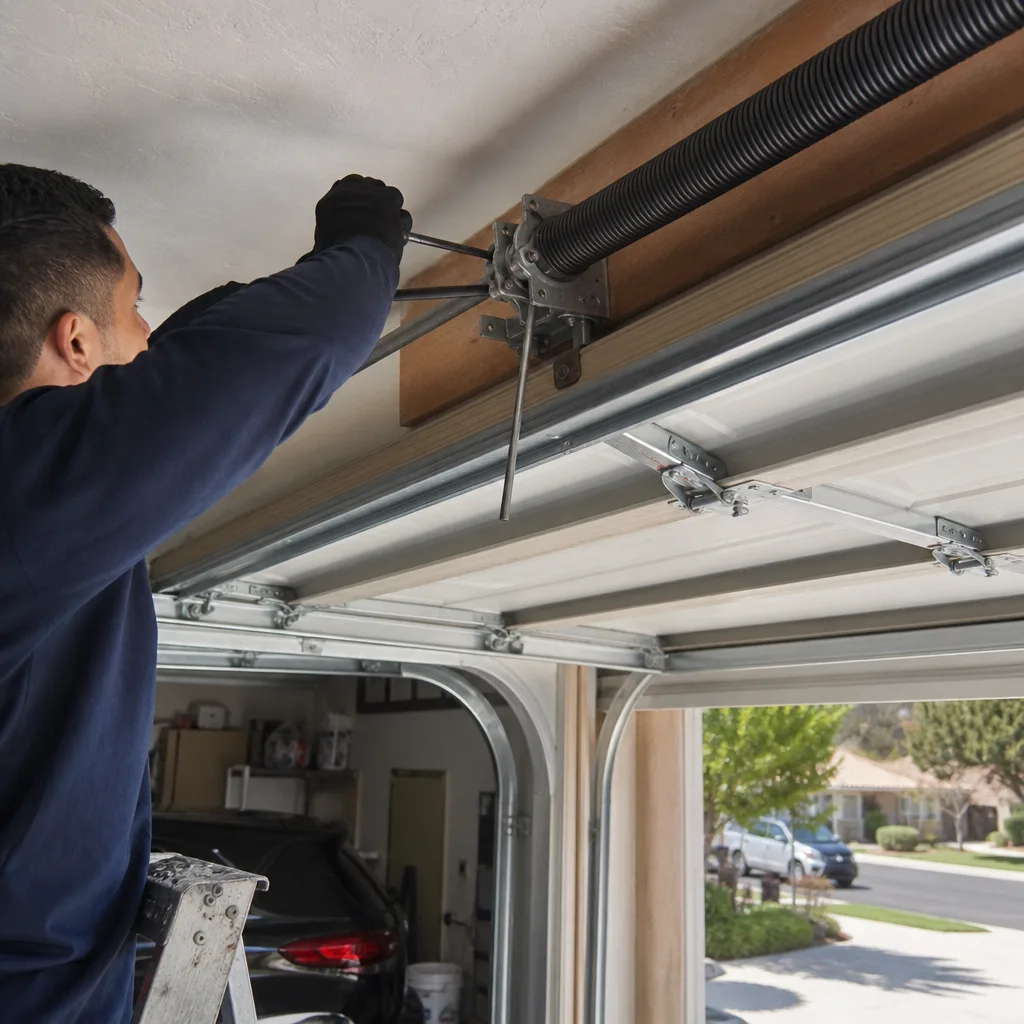
Torsion Spring Replacement
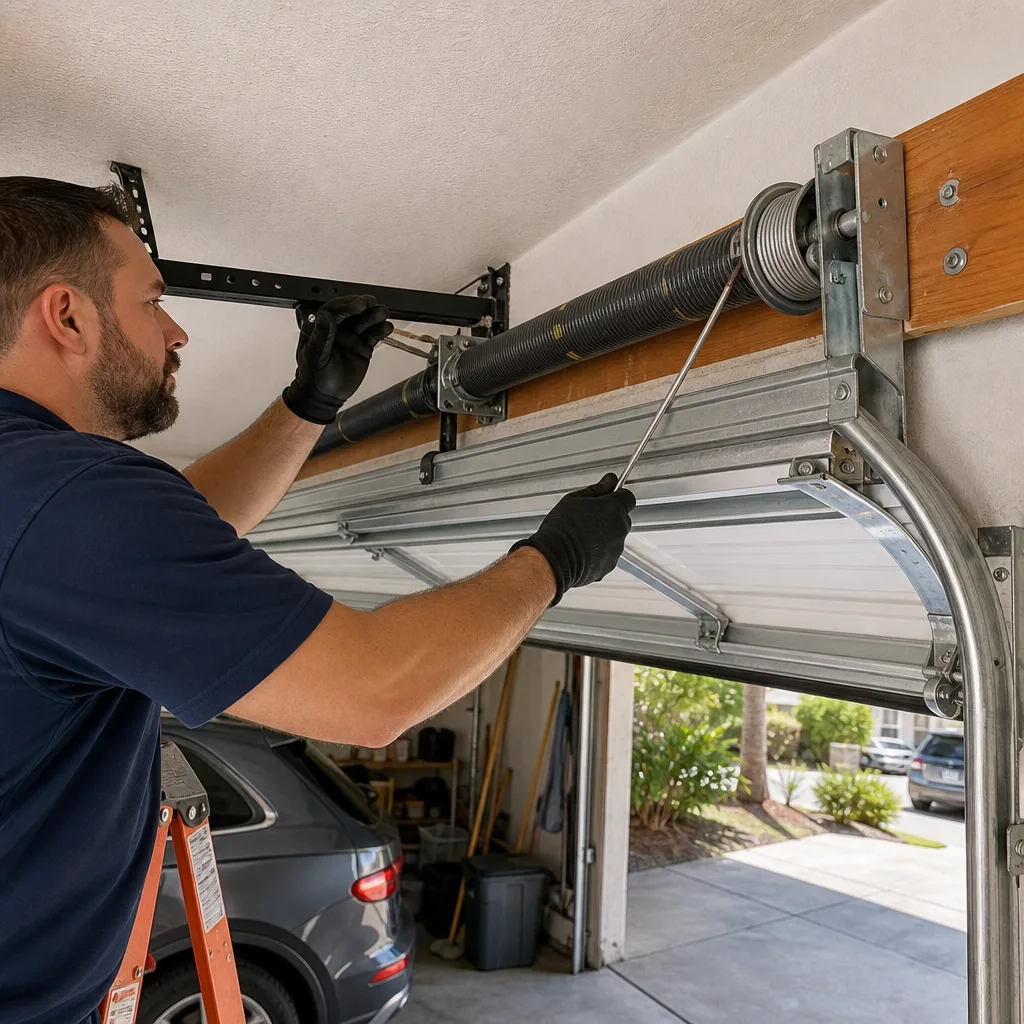
We covered the physics above. The practical reality is that proper spring replacement requires:
- Correct spring sizing by door weight, drum type, and lift height - not by matching the old spring’s paint color or dimensions, which are often wrong from a previous amateur replacement
- Winding bars of the correct diameter inserted fully into the cone, never adjustable wrenches or screwdriver substitutes
- Knowledge of whether your door uses a standard-lift, high-lift, or vertical-lift configuration, common in Jamul’s RV-height garages
- Release of tension from the old spring before removal, a procedure that itself carries risk
A mismatched spring causes the door to run heavy, burning out the opener motor within months. An over-wound spring snaps prematurely. An under-wound spring lets the door drift down, creating a crushing hazard. The garage door repair in Jamul that follows a DIY spring attempt typically costs 40% more than the original call would have, because we must also replace damaged cones, cables, or bottom fixtures.
Cable Work
Cables transfer spring torque to the bottom brackets. When a cable frays or jumps its drum, the door hangs unevenly. The temptation is to reseat the cable with the door partially open. Do not. The remaining spring is still fully loaded, and the uneven load can shift suddenly. Cable replacement requires releasing spring tension first, which returns us to the torsion hazard.
Structural Header and Track Mounting
The header above the door carries the entire door weight through the spring anchor bracket. In Jamul’s older homes, particularly the ranch-style builds from the 1970s and 1980s near Campo Road, headers sometimes sag or split from decades of load cycling. Reattaching or sistering a header involves temporary support of the door load, precise calculation of point loads, and often permit-aware work. The City of San Diego’s building jurisdiction, which covers Jamul, requires permits for structural modifications to load-bearing members. See our guide to Garage Door Permits, Codes & Inspections in CA: What You Need to Know for details. A failed header drops the door and damages the opening framing.
Opener Rail and Trolley Work Above Head Height
While not as immediately dangerous as springs, working overhead on a ladder with a 30-pound opener rail assembly invites falls. The rail must be level to within 1/8 inch over its length, and the trolley chain or belt tension must match factory specification for your model. A rail that droops causes the door to bind; an overtightened chain strips the nylon gear in the opener head. Garage door opener in Jamul installations are best left to technicians with the proper rail supports and angle iron.
How to Assess Your Own Garage Door Setup
Before deciding whether a task is within reach, you need to know what you’re working with. Five minutes of observation tells most of the story.
Step 1: Identify Your Spring System
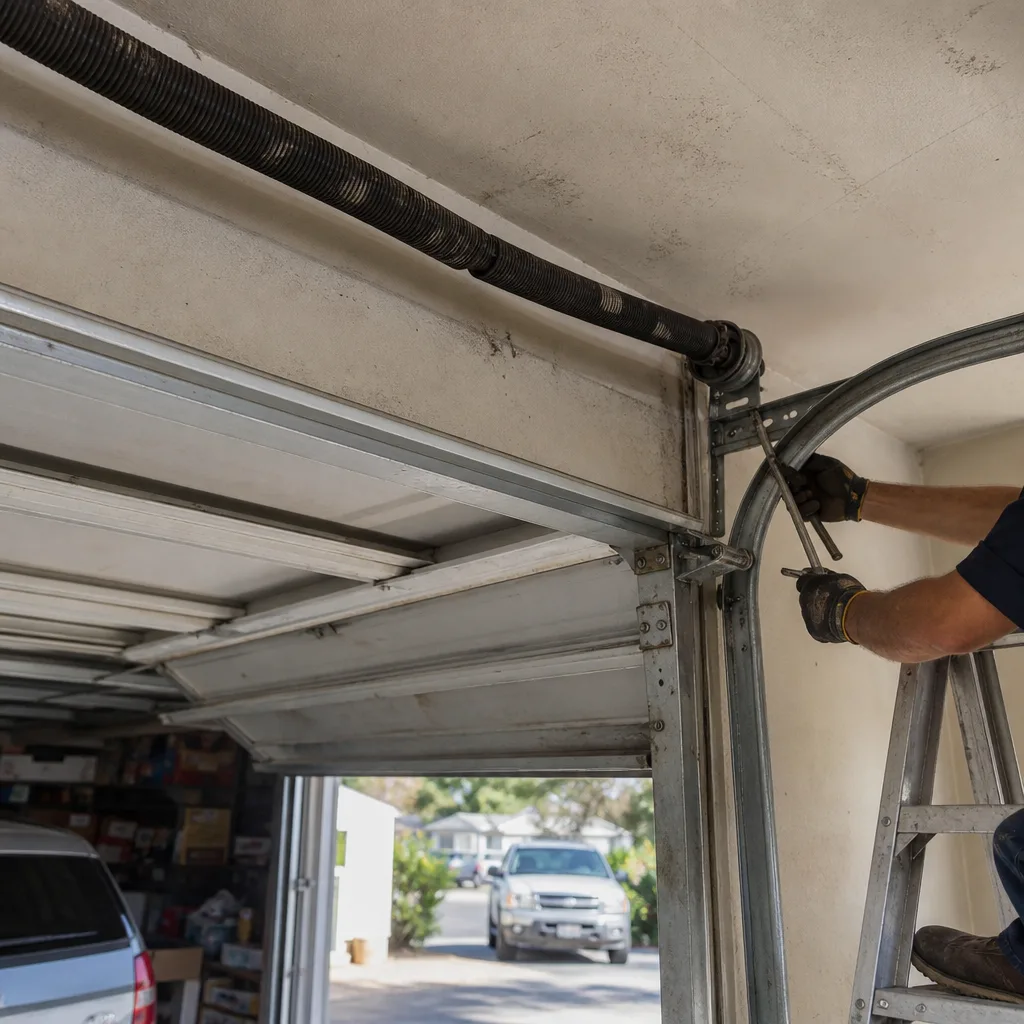
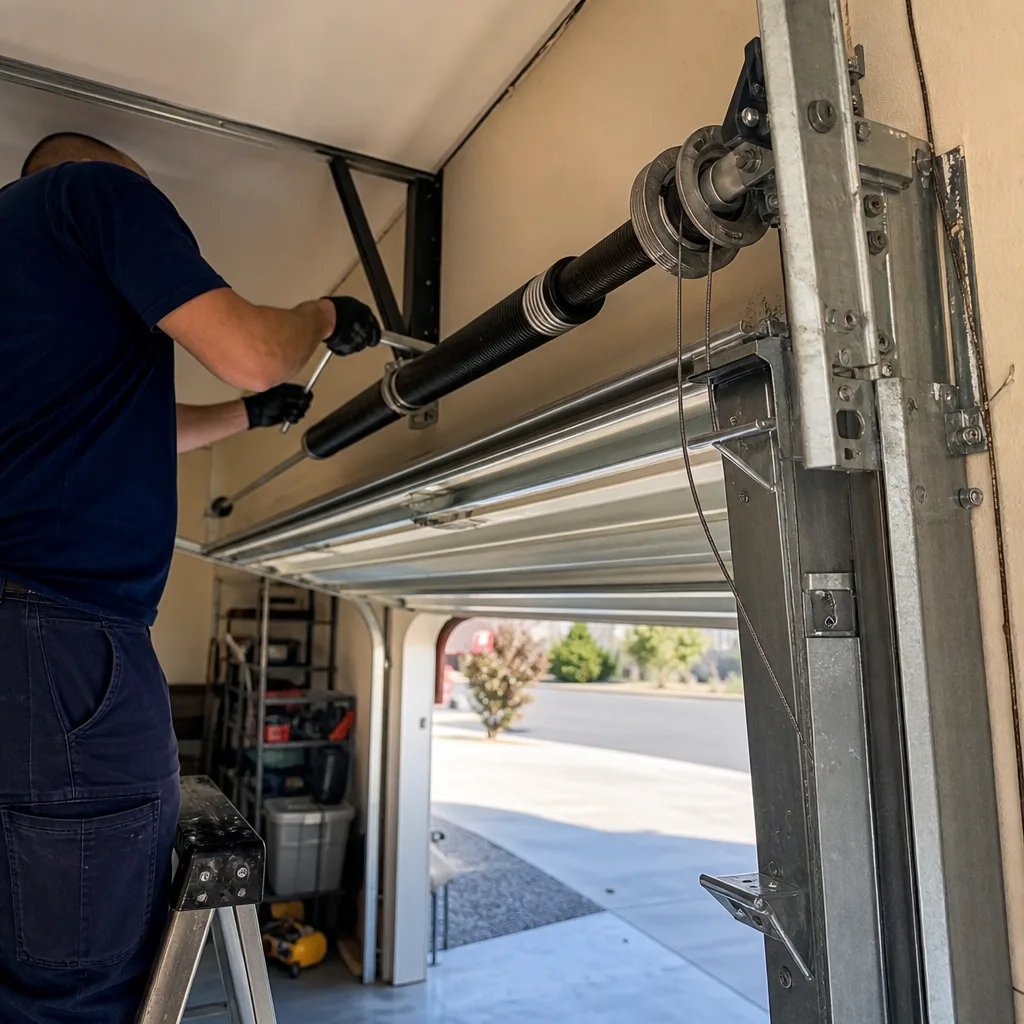
Look above the door. A single or pair of horizontal springs mounted on a steel shaft is torsion. Springs running parallel to the horizontal tracks on either side, often with visible pulleys, are extension. Torsion systems are standard on doors installed after 1990 and on any wind-rated or insulated door. Extension systems persist on older Jamul homes and on lightweight single-car doors. Extension spring replacement is slightly less dangerous than torsion but still requires knowledge of initial tension and safety cable condition that most homeowners lack.
Step 2: Check Door Weight Class
A non-insulated 16-foot steel door weighs 150-180 pounds. An insulated or wind-rated door of the same size, common in Jamul’s exposed hillside locations, weighs 220-280 pounds. The spring must be sized to the actual weight, not the door dimensions. We have found doors in the Rancho Jamul Estates area with 250-pound wind-rated panels sitting on springs spec’d for 180 pounds. The opener strains, the springs fatigue early, and the homeowner assumes the opener is failing when it is actually carrying excess door weight.
Step 3: Count Your Springs
Single torsion spring systems were common through the early 2000s as a cost-saving measure. They work harder, cycle fewer times, and fail more dramatically because there is no redundancy. A broken single spring means the full door weight drops onto the opener, which is not designed to hold it. Dual spring systems balance the load and typically last 20,000-30,000 cycles versus 10,000 for a single. If you have a single spring and it breaks, do not attempt to operate the door manually - the weight will overwhelm the opener or your back.
Step 4: Inspect the Cables and Drums
With the door closed, look at the cable where it wraps around the drum at the top of the vertical track. Fraying, rust staining, or a cable that sits unevenly in the drum grooves signals imminent failure. Also check whether the door sits level in the closed position. A gap under one corner usually means a cable has stretched or slipped.
Step 5: Test the Door Balance
Disconnect the opener by pulling the red release handle. Lift the door manually to waist height and release. A properly balanced door stays in place or drifts slowly. A door that slams down is spring-heavy; one that rises is spring-light. Either condition strains the opener and creates a hazard. Do not attempt to correct balance yourself. Note the behavior and call for service.
The True Cost of a Botched DIY Repair in Jamul
We are straightforward about pricing because we have seen the alternative. Here is what a failed DIY attempt actually costs in our market, based on calls we have run in Jamul over the past several years.
| Scenario | Typical Original Professional Repair | Cost After Failed DIY | What Went Wrong |
|---|---|---|---|
| DIY spring replacement with wrong wire size | $280-$380 | $520-$680 | Door ran heavy, stripped opener gear, damaged bottom brackets from uneven lift |
| Cable reseated without tension release | $180-$260 | $340-$480 | Cable jumped drum, bent track, door jammed at angle requiring realignment |
| Header “sistered” without temporary support | $800-$1,400 | $1,800-$2,600 | Door dropped, damaged jamb framing, required permit and inspection |
| Opener rail installed unlevel | $450-$650 | $620-$840 | Door bound at mid-travel, damaged top section, stripped trolley |
These figures include our standard diagnostic and labor rates in the Jamul area. The premium for undoing amateur work comes from the additional time to assess collateral damage, the parts that were damaged by incorrect operation, and sometimes the need to work around unsafe temporary fixes. We do not charge extra to shame anyone - we charge for the additional work.
There is also the less tangible cost: the door that fails when you need it. A botched spring job that holds for three weeks, then snaps at 10 PM with your vehicle inside and a family member needing to reach a medical appointment, is not a savings. It is a deferred emergency at the worst possible moment. Our phones are staffed by a live person 24/7, including nights, weekends, and holidays, but an emergency dispatch at off-hours carries the trip charge and urgency premium that a scheduled repair avoids.
The garage door installation in Jamul market includes some out-of-area companies that advertise low dispatch rates but add equipment and fuel surcharges once on site. Our flat price is stated before any work begins. The price you agree to is the price on the bill. When we quote a repair, it includes the full scope - not a teaser rate that balloons.
The Middle Path: Prep Work That Saves Money Without Risk
You do not have to choose between full DIY and writing a blank check. Several tasks reduce our billable time without exposing you to danger. We appreciate homeowners who have done this groundwork, and we pass the time savings through in lower labor charges.
- Clear the garage floor around the door. Move vehicles, storage bins, and anything that blocks ladder placement or panel removal. A clear workspace saves 15-30 minutes of move-and-return time.
- Remove old weatherstrip before we arrive. If you have already diagnosed the seal failure, pull the old T-seal or bulb seal from the retainer. We will measure, cut, and install the correct replacement in minutes rather than charging for removal time.
- Vacuum track debris and spider webs. Jamul’s dry climate means fine dust accumulates in the track curves, and black widow webs are common in undisturbed garage corners. Clean tracks let us assess roller condition accurately and reduce the chance of debris falling into mechanism during repair.
- Test and document the opener behavior. Note whether the issue is intermittent, whether it happens only in cold mornings, whether the wall button works when the remote doesn’t. Specific observations cut diagnostic time substantially.
- Photograph the spring, cable, and any visible part numbers. If you can safely photograph the spring windings, cable condition, and any stickers on the door interior or opener motor, we can often confirm parts availability before dispatch. Our trucks carry springs, cables, and openers for most major brands, but a heads-up on an unusual Wayne Dalton TorqueMaster or an older Raynor configuration lets us double-check stock.
- Ensure power to the opener and test the outlet. A surprising number of “opener failures” are tripped GFCIs or loose outlet wiring. Confirm the motor housing has power before calling - if the issue is electrical upstream of the opener, that falls outside our scope and saves you a service charge.
These steps do not require tools beyond a vacuum, camera, and flashlight. They can reduce a standard repair call by 20-30 minutes, which translates directly to labor savings on your invoice.
When to Call a Professional
Call when the repair involves stored mechanical energy, structural load-bearing components, or precision alignment that affects safety. Specifically: broken or sagging springs of any type; frayed, detached, or uneven cables; doors that slam, drift, or refuse to stay open; bent or separated track sections; opener motors that hum without moving the door; and any door that has been struck by a vehicle, even if it still operates. Impact damage often misaligns the track or stresses the header in ways that worsen with continued use.
In Jamul, where many homes sit on expansive soils and seasonal temperature swings stress metal components, annual inspection by a trained eye catches fatigue before failure. Our $89 Seasonal Tune-Up includes spring torque verification, cable and roller inspection, track alignment check, safety reversal test, and opener force limit verification. It is not a sales visit. If nothing needs attention, we say so.
Mainspring Garage Door Co. offers free estimates in Jamul - call (619) 333-5822. The price is quoted and agreed before any work starts. No surprises on the bill.
Frequently Asked Questions
Professional torsion spring replacement in Jamul typically runs $280-$420 for a standard residential door, depending on whether you have a single or dual spring system, the wire size required for your door weight, and whether the cables or bottom brackets also need replacement. We state the flat price before any work begins. Call (619) 333-5822 for an exact quote - estimates are free.
No. Dual springs are matched pairs, wound to the same specification. Replacing one creates unequal torque that strains the opener, wears the new spring prematurely, and causes the door to run unevenly. Both springs should be replaced together, even if only one has broken. This is standard practice for any reputable technician.
No. Our flat price is stated before any work begins. The only circumstance that changes the quote is if you authorize additional work beyond the original scope - for example, if you ask us to also replace worn rollers while we are already servicing the springs. Even then, we state the additional cost and get your approval before proceeding. No surprises on the bill.
Most spring replacements are completed in 45-90 minutes, and our trucks carry the common spring sizes for Jamul’s standard door configurations. We complete most jobs in a single visit. If you have an unusual door weight or a specialized system like a Wayne Dalton TorqueMaster, we may need to order parts, but we will tell you that during the initial call or estimate.
Yes. Our trucks are stocked with torsion and extension springs, cables, drums, rollers, hinges, weatherstrip, and opener components for LiftMaster, Chamberlain, Genie, and other major brands. Most repairs are completed in a single visit without waiting on parts. Call (619) 333-5822 to confirm availability for your specific model.
If you have a dual spring system and one spring is intact, you can lift the door with significant effort, but it will be heavy and may drift down. If you have a single spring system and it breaks, do not attempt to lift the door. The full weight of the door - 150 to 400 pounds depending on construction - rests on the opener or your back. The risk of the door slamming or your losing control is substantial. Disengage the opener, leave the door closed, and call for service.
The Bottom Line
The DIY-versus-professional question is not about whether you are capable. It is about whether the specific task allows capability to matter. Sensor alignment, lubrication, weatherstrip, and remote programming reward careful attention and save you money. Torsion springs, cables, structural work, and precision alignment do not - the hazard is inherent in the component, and the cost of error compounds quickly. In Jamul’s market, where a failed DIY repair typically adds 50-80% to the eventual professional bill, honest self-assessment at the task level is the smartest home maintenance skill you can exercise. Do what is safe. Call for what is not. Either way, know the line before you cross it.
Written by Carl Dutton, Owner at Mainspring Garage Door Co., serving Jamul since 2016.